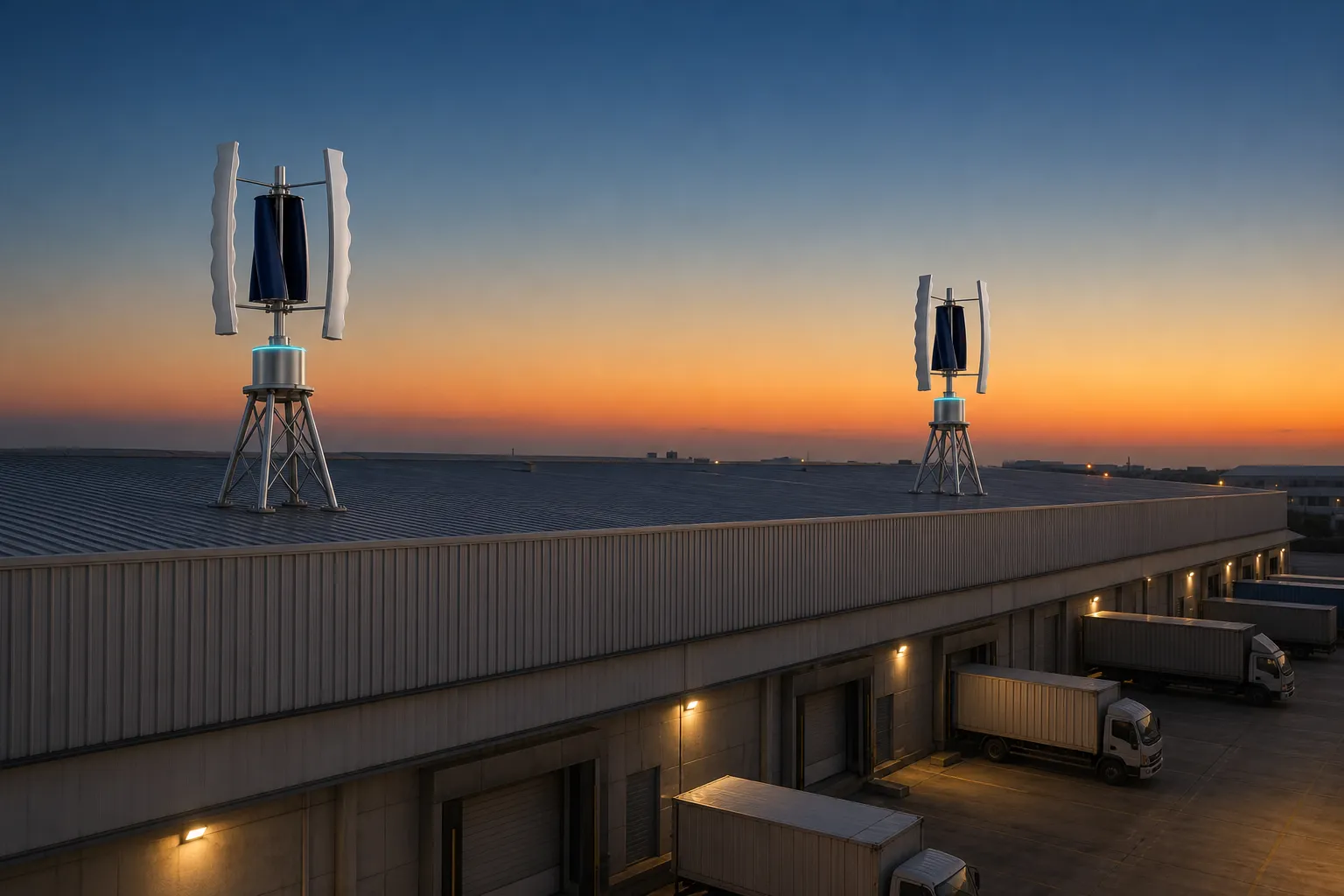
A warehouse pays for electricity shaped like a clock. If it has solar, it buys generation shaped like a day. The hours in between are the whole argument for wind turbines for warehouses — and the reason warehouse rooftop wind reads differently on an industrial shed than on a house.
Two things about the building do that work, not the machine: open industrial land clear of the airflow-blocking clutter a city rooftop carries, and operating hours that run well past sunset.
The commercial shape, before any of the detail: there’s no machine to buy. GIVARA installs, owns, insures and maintains it, and the site pays only for the units it actually generates, priced below the electricity board’s rate — a modelled commercial target that varies by site, never a guarantee.
And the part most vendors leave out: about a week of real measurement happens first, and if the roof doesn’t have the wind, GIVARA says so and walks away.
Nothing is running in the field yet — GIVARA is building toward its first installations, with six IP filings made in 2026, filed and not granted. This page is one branch of the wider map of wind energy for business in India.
Half a billion square feet, and compounding.
Why warehouse wind energy starts with India’s warehousing scale
A warehouse roof isn’t a spare surface — it’s a vast working plane that mostly sits unused, and the category keeps compounding with every reporting cycle as more sheds go up along India’s industrial corridors and logistics parks.
None of the scale below turns into a promise about any one roof; what it does show is that the opportunity isn’t a one-off, it’s structural.
A warehouse's day doesn't end when solar's does.
Where a wind turbine for warehouse roofs fits once the sun is down
Lay a warehouse’s actual working day against what solar and wind can each deliver, and one shift stands out for the wrong reason. A household’s load tapers off after dark. A warehouse’s doesn’t:
- Sorting lines keep moving.
- Yard and security lighting stays lit.
- Dock operations keep turning over past sunset.
- Cold-chain refrigeration never clocks out — a cold store’s compressors run around the clock by design.
Solar has nothing to offer through Shift C, and that isn’t a flaw in solar — it’s simply how sunlight works, the same honest limit that shows up on any roof.
The difference for a warehouse is how much of its actual electricity use falls into that gap: fleet depots have their own overnight rhythm of vehicles staged and loads checked long after the gates would otherwise be quiet.
Wind doesn’t share solar’s limit, which is why this reads as a co-existence story, not a replacement one.

Solar keeps the sunlight, wind takes the corner.
How warehouse rooftop wind sits alongside an existing solar array
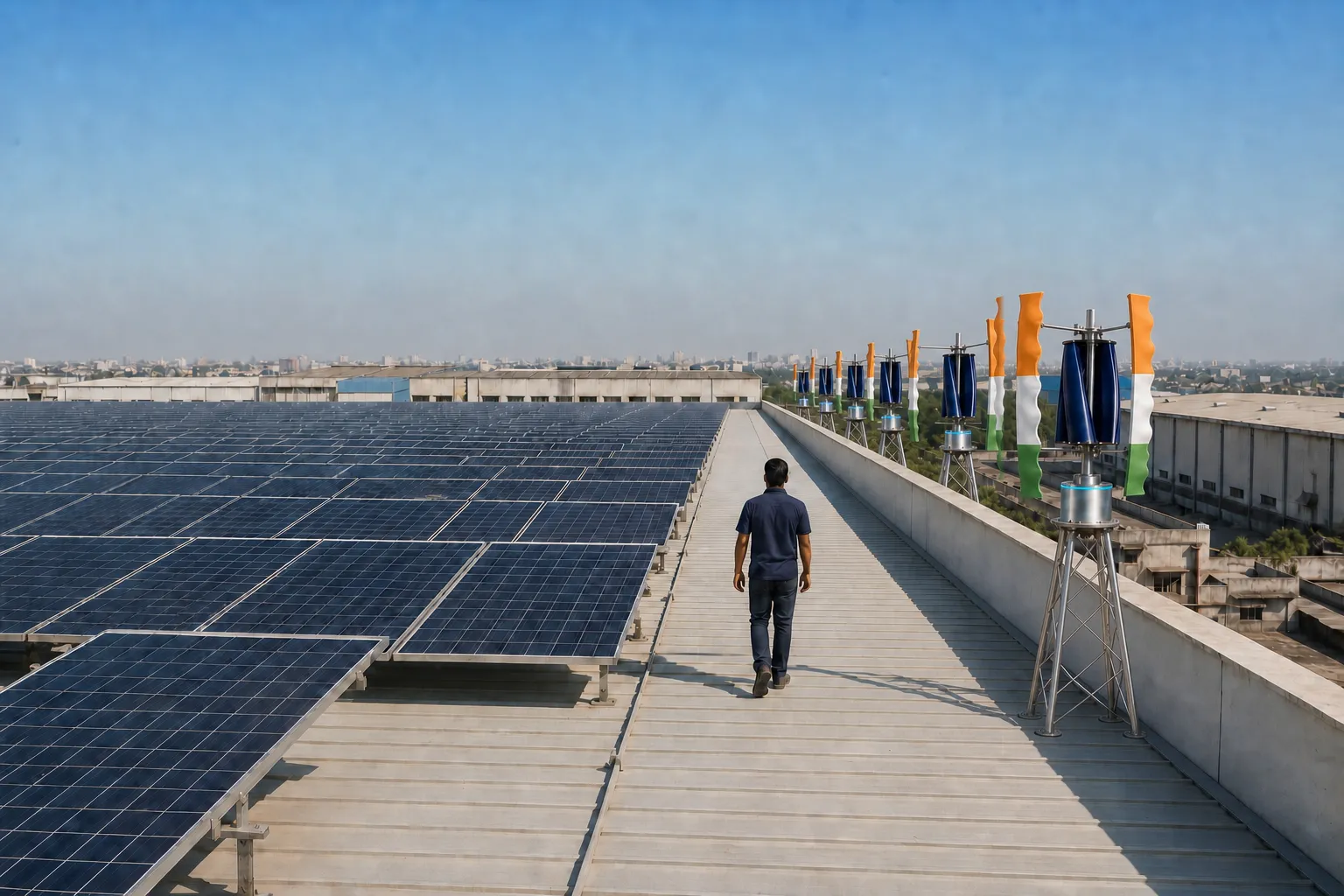
Solar is never the rival here. Most warehouses that have gone solar have covered the flatter, most consistently sunlit stretches of roof with panels — exactly where solar should sit.
What’s left over is the parapet edge — and on a wide, low shed that edge is not the consolation prize. It is the best air on the building.
Wind meeting a large flat roof has to go over it, and it speeds up as it lifts across the edge. The same geometry that makes a warehouse roof boring for solar at the perimeter — long, flat, unobstructed, nothing tall upwind — is what makes the edge worth standing a machine on.
That’s where a compact wind turbine for warehouse roofs fits — on its own stand, without asking a solar installer to give up a single panel’s worth of space.
The two also cover different weeks of the year, not only different hours.
India’s own generation record shows it plainly. Across 2025–26, the national wind fleet out-generated the national solar fleet in exactly three months — June, July and August. July was wind’s strongest month of the year and solar’s weakest.
Wind’s monthly output swung close to fourfold across that year. Solar’s moved by roughly half as much — steadier, but with its floor in exactly the months wind peaks.
That is grid-scale wind in India’s windiest states, not a reading off any one roof. It doesn’t predict a warehouse — but it is the clearest evidence available that the two resources are strongest at different times of year, and that the monsoon is when they diverge most.
Wind keeps working through both the night shift and the cloud cover — a warehouse roof with both ends up with two differently-shaped sources pointed at the same electricity bill, not one competing with the other.
One assessment covers a lot more than one roof.
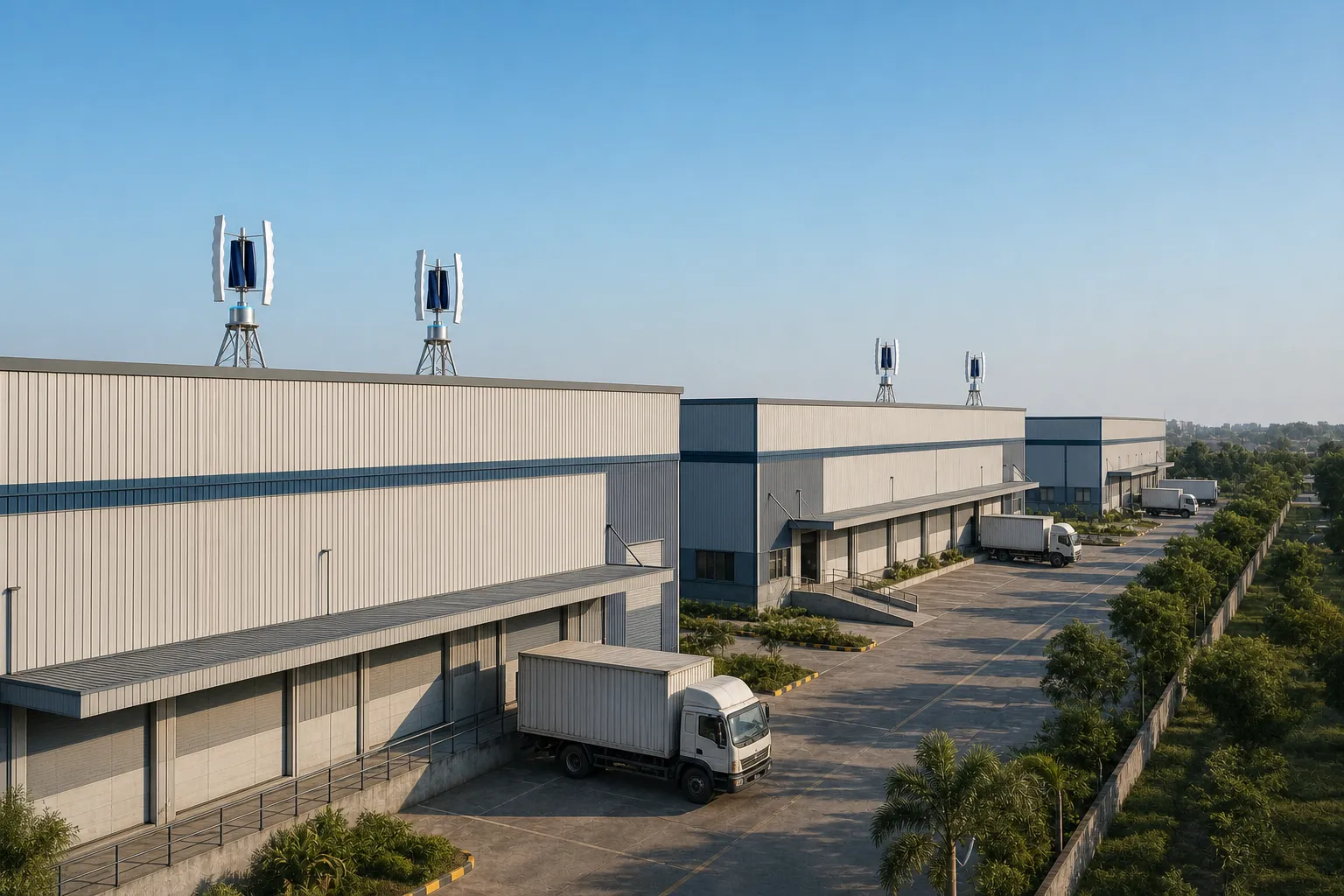
A single warehouse is one roof and one conversation.
A logistics park is several roofs under one operator, which changes the shape of the logistics park energy picture, not the process.
Where the site has the space and the wind, a park’s scale can make room for more than one machine, spread across different sheds or different corners of the same large roof, wherever the assessment finds usable airflow.
Still, that’s a possibility one assessment conversation confirms site by site, never a claim about what any particular park will end up with.
There’s also real headroom on the certification side: as of 2021, only 19 pilot projects, covering over 19.7 mn sq ft, were registered under IGBC’s green logistics rating.
No refresh has been published since, so the current count isn’t known — but the category has grown far faster than its certification uptake, and that gap is the early-mover room.
Logistics-park operators who want a bigger role in the rollout can start with becoming a GIVARA partner.
There's nothing here for the facility to buy.
Wind turbines for warehouses, paid for as electricity, not equipment
For an operator used to capital-expenditure conversations — quotes, financing, depreciation schedules — warehouse wind energy works the other way round, because there’s no machine to buy.
GIVARA installs, owns, insures, and maintains GIVARA ONE on the roof — backed by the same GIVARA Care layer that watches every machine GIVARA puts up.
The facility pays only for the electricity it actually generates, measured at the meter, priced below the electricity board’s rate.
What it costs to start — the reservation, the refundable deposit, and exactly what each one covers — is set out on the GIVARA ONE page. Those figures are kept in one place, so there’s a single set of numbers to check rather than a different version on every page.
See Wind Energy-as-a-Service, explained for the fuller shape of the model, and who pays if it breaks for what GIVARA carries once the machine is on the roof.
Warehouse roofs are already a national headline.
What the business press is actually reporting
None of these headlines are about wind. They’re about how much warehousing India is building, and about the weeks when solar output dips.
Frequently asked questions
How much does it cost to set up a wind turbine on our warehouse?
There’s no machine to purchase. GIVARA installs, owns, insures, and maintains the turbine as a service, and the facility pays only for the electricity it generates — measured at the meter and priced below the electricity board’s rate. The conversation starts with a site measurement, not a purchase quote.
Will it disturb warehouse operations or create noise issues on the floor?
The turbine sits on its own compact stand, engineered for that particular roof, in a corner away from the working roof surface, docks and yard operations below. GIVARA handles the structural and permission work, and a structural engineer’s honest look at the building comes before anything goes up, not after — most industrial roofs were never built with a spinning machine at height in mind. Placement and any noise considerations specific to that building are settled in the same assessment.
What if our site turns out to have weak wind?
Then GIVARA says so. The process begins with about a week of real wind measurement at the actual site, and if that measurement doesn’t show enough usable wind, the honest answer is that the site isn’t a fit — no installation goes ahead on a hopeful guess.
Can a rooftop wind turbine power the whole warehouse?
No, and it isn’t meant to. GIVARA ONE offsets a measured slice of the facility’s electricity use; the electricity board remains the primary supply. Think of it as a co-existing source alongside the grid and alongside solar, not a replacement for either.
We lease the building — who makes this decision?
Usually the occupier starts the conversation and the owner signs off anything fixed to the roof — most Indian warehouse leases put roof alterations and roof rights in the owner’s column, so those clauses are worth reading before the first call. GIVARA’s role is the assessment and the service itself; it does not replace the owner’s consent. What the assessment does is make the ask concrete, so the owner is approving a specific machine in a specific corner rather than an idea.
A warehouse roof rarely lacks for space. What it usually lacks is a second source of generation shaped for the hours solar can’t reach — which is exactly the case for a wind turbine for a warehouse in India.
If the load you’re covering is refrigeration rather than racking, wind power for factories and cold storage takes the same argument through a plant’s bill line by line. If you’re not yet convinced rooftop wind works at all, what actually works on Indian rooftops is the honest version — including the questions worth putting to any vendor, GIVARA included.
Or start with does my roof have enough wind to see what your own roof can actually offer, and browse use cases for other sites where rooftop wind tends to make sense.
Your roof could be next — measurement first, always
TELL US ABOUT YOUR SITE