
“Doesn’t work here, na? I saw one on a hotel roof once, barely moving.” That’s the usual line on rooftop wind turbines in India — and it isn’t paranoia. It was earned, honestly, over a decade of disappointing machines.
Machines that looked good in a brochure did almost nothing once bolted to a roof. This page is about what actually works — why that reputation stuck, and what’s genuinely different now.
Most usefully, it ends with the questions that expose any vendor — ours included.
That slow, sad machine on a hotel roof — everyone has seen one.
Why rooftop wind turbines in India earned a bad name
Most small wind turbines sold for Indian rooftops have been shrunk-down versions of the big horizontal-axis machines standing in open wind farms in Gujarat or Tamil Nadu — three long blades on a horizontal shaft, facing into the wind like an aeroplane propeller.
Out on a wind farm, that design is genuinely excellent. The land is flat, the wind arrives from a fairly consistent direction, and there’s nothing nearby to disturb it.
A rooftop in Lucknow or Pune is a completely different wind environment. Air doesn’t arrive politely from one direction:
- It bounces off the water tank next door
- It funnels between two buildings of different heights
- It curls around a parapet wall
- It changes direction every few seconds
A horizontal-axis turbine has to physically turn — yaw — to keep facing whatever direction the wind happens to be coming from. On an open plain, it turns occasionally. On a crowded urban roof, it would need to turn constantly — and by the time it’s caught up to one gust, the wind has already shifted again.
The turbine spends much of its life chasing the wind instead of catching it. That’s the honest, unglamorous reason so many rooftop installations ended up as slow, sad ornaments — not because wind doesn’t work in India, but because the machine was designed for a wind farm and then bolted onto a rooftop it was never built to understand.

City wind never arrives politely — so the machine must not care.
What a vertical-axis wind turbine changes on an Indian roof
A vertical-axis wind turbine (VAWT) — the kind that spins around an upright shaft rather than a horizontal one — doesn’t need to face the wind at all.
It can accept air from any direction, all at once if needed, without turning to chase it. For the swirling, direction-shifting air above an Indian street, that removes an entire category of rooftop-specific failure.
There’s no yaw mechanism lagging behind a gust that’s already gone. Vertical-axis machines also tend to sit lower and quieter — which matters when the “wind farm” is your own terrace and the nearest thing to it is a bedroom window.
The same gusts. Two very different machines.
A propeller must physically turn to face every gust. On a city roof the wind shifts in seconds — the machine is always catching up to a gust that has already gone.
A vertical-axis machine takes wind from every direction at once. Nothing turns to face the gust, so nothing is ever late — the machine stops being the reason a windy roof produces nothing.
None of this makes vertical-axis wind a magic fix. A badly designed VAWT can still under-perform — the usable wind above your specific roof still depends on your building’s height and what’s around it. No design change alters how much wind exists at your address.
What vertical-axis architecture removes is the machine itself as the reason a windy roof produces nothing.
One contributor to a bill — not a private power station.
What a realistic rooftop wind expectation looks like
Here’s the honest baseline: a rooftop wind machine is not a wind-farm turbine, and nobody should expect it to run a whole household off wind alone.
For a home in India, a small wind turbine is one contributor to a bill, not a replacement for the grid.
Where it earns its place is in the hours solar can’t touch — after sunset, through the evening peak, and in the monsoon’s grey weeks when rooftop solar output falls away. Wind doesn’t check the clock.
What it can’t do is give you one clean number for every roof. Two roofs a street apart can behave differently depending on height and what surrounds them.
Any output figure not grounded in wind measured at your site is a guess dressed up as a fact.
Don't judge the pitch — judge the answers.
The questions to ask any rooftop wind vendor — including GIVARA
Honesty is easier to claim than to prove. Judge a vendor by what they’ll do, not what they say.
Six questions. Ask them of anyone — us included.
- 01
Will you measure the wind at my actual roof before quoting me?
✓ A STRAIGHT ANSWER“Yes — we measure at your site, over a real stretch of time, before any number.”
✕ A DODGE“Our spec sheet covers every roof.”
- 02
What happens if my roof doesn't have enough wind?
✓ A STRAIGHT ANSWER“We say so plainly, walk away, and return your money.”
✕ A DODGE“The numbers can usually be made to work.”
- 03
Who owns the machine — and who carries the repair when it breaks?
GIVARA'S FULL ANSWER: IF IT BREAKS, WHO PAYS →✓ A STRAIGHT ANSWER“We do. When something breaks, the roof visit is ours, not yours.”
✕ A DODGE“Warranty terms apply — it's all in the fine print.”
- 04
Is the output you're quoting measured or estimated?
✓ A STRAIGHT ANSWER“Estimated until your roof is measured — and we label it that way.”
✕ A DODGE“It's an industry-standard figure.”
- 05
Can I see the actual machine spinning on a real roof?
✓ A STRAIGHT ANSWER“Yes — a real machine on a real roof, not a render.”
✕ A DODGE“Here's an animation of the upcoming model.”
- 06
Who talks to my RWA or society about approval?
✓ A STRAIGHT ANSWER“We present to them, and we take their hard questions.”
✕ A DODGE“Approvals are the customer's responsibility.”
A vendor with nothing to hide answers the question you asked — with specifics you can check.
A vendor with nothing to hide answers these directly, with specifics you can check. A vendor selling hype answers a different, easier question than the one you asked.

Built for exactly this air — and run as a service.
A rooftop wind turbine built for Indian roofs — and run as a service
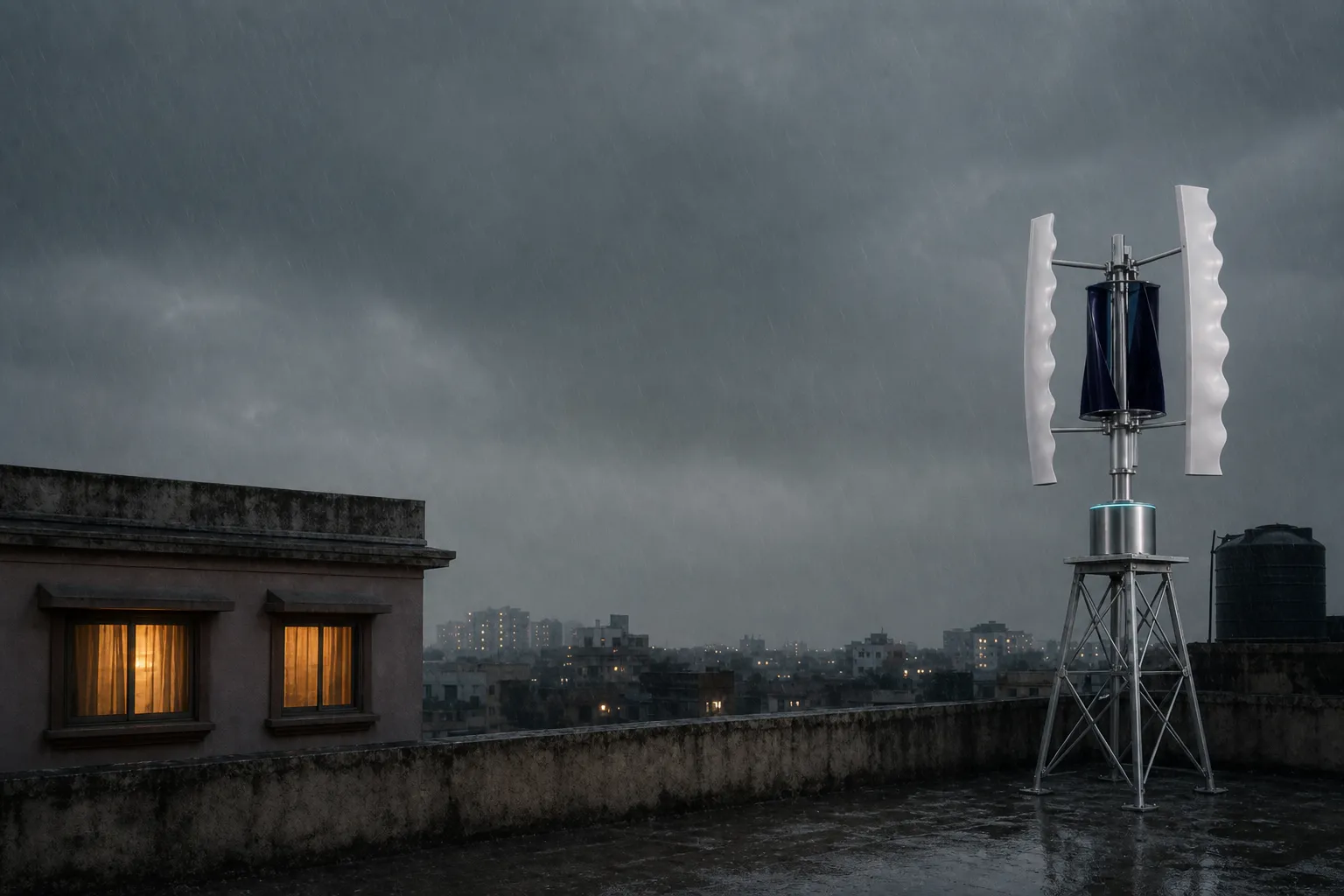
GIVARA ONE is a vertical-axis rooftop machine engineered for turbulent, direction-shifting Indian rooftop air — not a wind-farm design shrunk to fit a terrace.
It’s still being engineered and proven through field testing. Pre-booking opens in Q4 2026 — no customers or case studies yet, because there shouldn’t be, this early.
The commitment is the one the questions above demand: once quoting begins, GIVARA measures a roof’s actual wind before pricing anything — and says so plainly and steps back if the numbers don’t support installation.
GIVARA has filed IP around the design: three provisional patents and three design applications, filed in 2026 — filed, not granted.
It also comes as a service: you’d never buy the turbine. GIVARA would own it, insure and maintain it, and you’d pay only for the electricity it actually generates — priced below the electricity board’s rate.
That’s the structure of “India’s first Wind Energy-as-a-Service platform” — not a slogan, an ownership arrangement that puts the risk on us, not you.
If you’re weighing a site, the range this can make sense for is worth a look at use cases — and if you could bring rooftops into this story, there’s a path to become a partner.

Frequently asked questions
Is rooftop wind actually proven technology, or is it still experimental in India?
Wind power at utility scale — the big turbines in open fields — is thoroughly proven and has been generating power in India for decades. Small-scale rooftop wind is newer terrain, and quality varies enormously between designs. The honest answer isn’t a blanket yes or no for the whole category; it’s that any specific machine’s claims should be checked against your own roof’s measured wind, not against a national verdict either way.
Can a rooftop wind turbine replace my solar panels?
No, and it isn’t trying to. Solar and wind are complementary, not competing — solar peaks at midday when wind is often calmer, while wind can keep contributing after sunset and through cloudy, low-sun stretches when solar output drops. A roof that already has solar isn’t wasting a wind machine; the two cover different hours.
Will a rooftop wind turbine disturb my neighbours or need special approval?
It depends on the design and the building. Ask any vendor for their stated noise design targets and how the machine has actually performed against them, not just a marketing claim. For flats and societies, ask specifically who presents to your RWA and what happens if they say no — that answer tells you a lot about how the company treats risk.
How do I actually find out if my roof has enough wind?
There’s only one honest method: measure it, at your site, over a real stretch of time — not a single windy afternoon, and not a city-wide wind map, which can’t account for your specific building’s height and what surrounds it. Two roofs on the same street can have meaningfully different wind because of how they’re boxed in by neighbouring structures. Anyone offering you a number without having measured your roof is offering you a guess.
Do rooftop wind turbines work during the monsoon?
The monsoon is when wind earns its keep — grey, low-sun weeks pull rooftop solar down while the moving air keeps coming. A machine built for Indian roofs treats rain, humidity and gusts as its operating environment, not an exception to it. Ask any vendor how their machine protects itself in violent weather — and who carries the repair if the weather wins anyway.
Start with whether your roof qualifies — measure first. See what a home wind turbine really costs and who pays when something breaks. Or read how the service model works end to end.
Your roof could be next — measurement first, always
TELL US ABOUT YOUR ROOF