
Search “vertical axis wind turbine home” and you’ll likely land on photos of the tall white three-blade machines lining highways near wind farms — and wonder why nobody puts something like that on a house.
The honest answer: the highway machines were never designed for a house. They were built for open farmland and offshore water — and a rooftop in Lucknow or a terrace in Pune is neither. A vertical-axis wind turbine is a different shape, built to answer a different problem.
A ceiling fan on its side — roughly.
What a vertical axis wind turbine actually is
The name describes how the rotor spins, not how tall the machine is. Turn a ceiling fan on its side, so the blades sweep around an upright pole instead of a horizontal one, and you have the basic idea — usually shortened to VAWT.
Engineers have tried dozens of variations on this shape for a century: curved-blade designs, scoop-shaped rotors, helical twists that look almost like a strand of DNA.
What every version shares is one defining trait — the rotor turns around a vertical shaft, never one that has to point into the wind.
The highway machines — are a different species.
Horizontal-axis turbines are a different machine entirely
The turbines you see from the highway are horizontal-axis wind turbines, or HAWTs — a big three-blade rotor on a tower, facing the wind the way a desk fan faces a room.
Because it has to point directly into the wind, it carries a motorised yaw system that swings the whole nacelle around at every direction shift.
On open plains and offshore, where wind arrives from a fairly steady direction, that works beautifully — it’s why wind farms use exactly this design. Thirty feet above a mixed city block, next to water tanks and parapets, the same assumption stops holding.
Rooftop wind is messy — the shape absorbs it.
Why rooftop wind wants a vertical-axis shape
Buildings funnel wind, tanks and parapets deflect it, and turbulence shifts by the hour in a way open farmland never sees. A machine that must keep re-facing the wind loses time realigning, and carries an extra motorised part that has to survive every monsoon.
A vertical-axis rotor accepts wind from any direction without turning to meet it — no yaw motor, no lag. It’s part of why rooftop machines earned their bad name — and what actually works.
Farmland never had this direction-shifting problem to solve. Rooftops do.
Quiet enough — to be forgotten.
Quiet, and built to be a good neighbour
The whoosh-whoosh of a large three-blade rotor carries, because its tips move fast across a wide, thin arc. A compact vertical-axis rotor runs at a much gentler tip speed, and reads more like a slow, solid drum turning, not a spinning blur.
That’s by design — whisper-quiet on the rooftop, judged by ear. The same slower rotation also makes it easier for birds to register as an object, rather than an invisible disc.
Not magic — a trade, made honestly.
VAWT vs HAWT: the honest trade-off
Under ideal, steady wind, a horizontal-axis turbine of similar size converts more of that energy into electricity — part of a VAWT’s rotor is always working against the wind as it completes its circle. That’s simply the physics of the shape.
What a VAWT buys with that trade: tolerance of constant direction change, gentler starting, fewer exposed moving parts, and a compact footprint.
the three-blade giant wins — peak efficiency, wide sweep, one steady direction
the vertical axis wins — any direction, no yaw motor, gentle starts
The honest pitch for a VAWT was never "more efficient" — it's "suited to the wind you actually have."
Anyone telling you a small rooftop turbine of any shape will out-produce a wind-farm giant, watt for watt, isn’t being straight with you.
The edge learned from — a fish.
Why the outer blades have wavy edges — a lesson from a fish
Look closely at GIVARA ONE’s outer blades and you’ll see the edge isn’t straight — it’s wavy, like the profile of a fish. That’s not styling. It’s the answer to the cost the last section just admitted.
A fish wades through water at speed because of its shape: resistance slips around its face and body instead of stopping it, and the fish keeps moving.
The returning blade has the same problem in air. As the rotor spins, each blade must come back around and cut through the air in its way. A flat, straight edge would slap against that air and pay for it in lost motion.
The wavy edge wades instead. It parts the air the way a fish parts water — so the blade slips through, and the rotor holds on to the momentum it has already earned.
That’s one of the design choices behind a machine engineered to waste less of the wind it catches — not by spinning harder, but by losing less on the way back around.
What a fish knows about resistance.
A fish doesn't fight the water — its shape lets resistance slip past, so it keeps its speed.
The wavy edge on GIVARA ONE's outer blades borrows the same trick for air.
As the blade comes back around, the edge parts the air instead of slapping against it — and the rotor holds on to the momentum it has already earned.
Two rotors — one job.
Inside GIVARA ONE: a dual-rotor vertical axis wind turbine
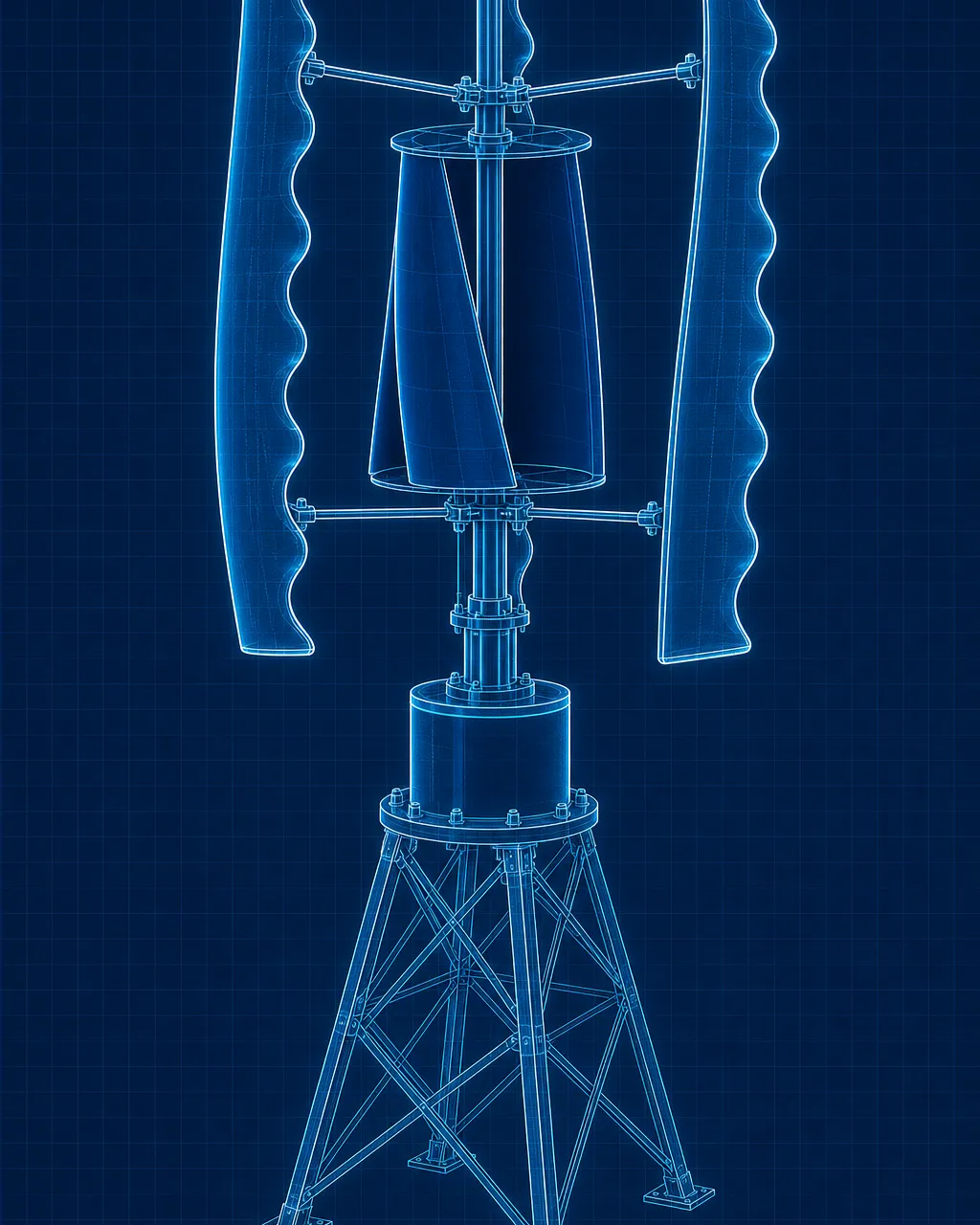
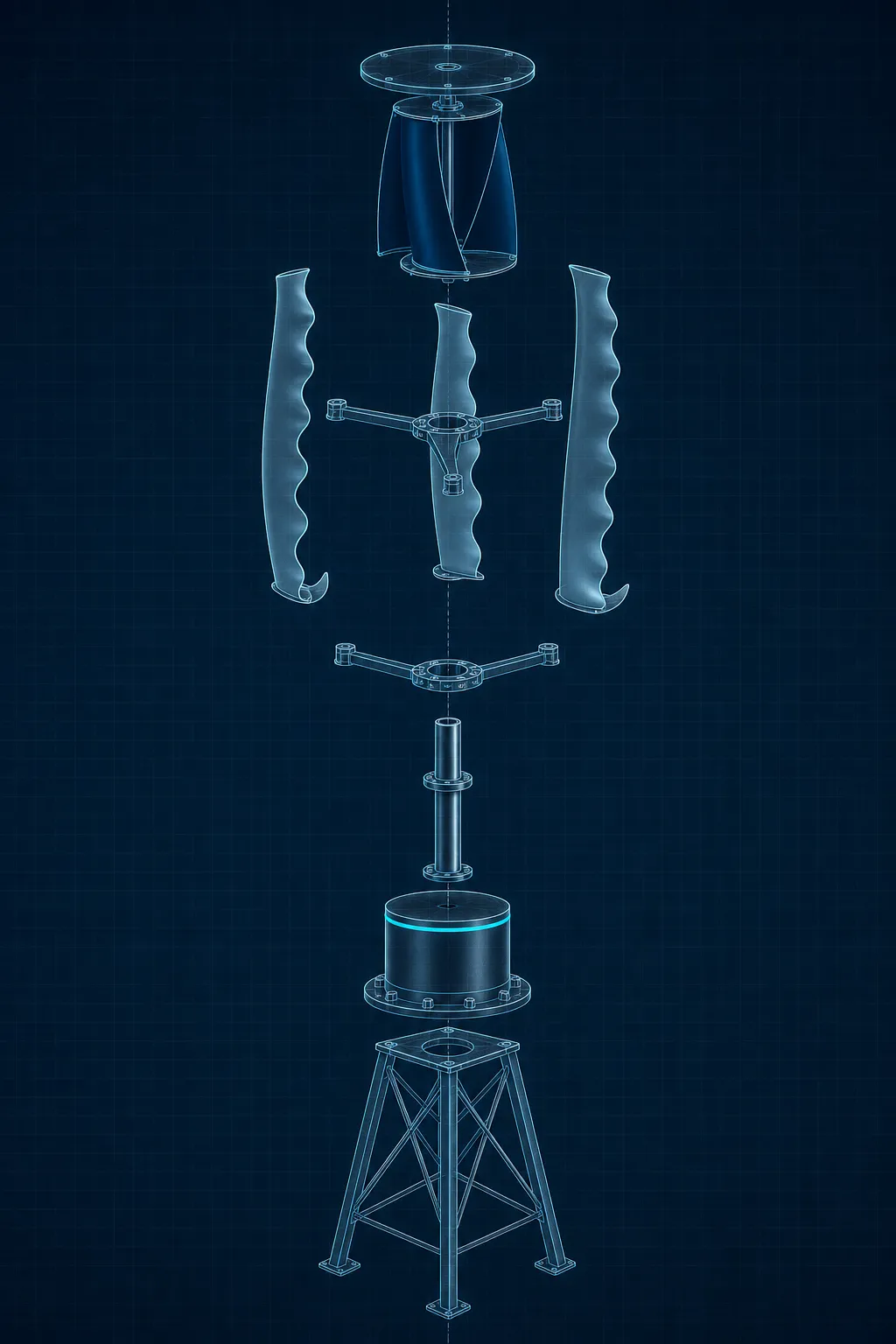
GIVARA ONE is a dual-rotor vertical-axis machine — a helical outer rotor wrapped around a self-starting inner rotor, working as one concentric assembly. The inner section starts turning in gentle, inconsistent wind; the helical outer rotor keeps that motion smooth, not jerky or stalling.
Six IP filings cover parts of this architecture — all filed in 2026, none granted yet, and that distinction stays stated every time.
Two rotors, one concentric assembly.
- 1HELICAL OUTER ROTORkeeps the motion smooth and continuous once started
- 2SELF-STARTING INNER ROTORbegins turning in gentle, inconsistent wind
- 3ONE CONCENTRIC ASSEMBLYtwo rotors working as one machine
- 4GENERATOR DRUMthe cyan ring is its heartbeat
- 5X-BRACED STANDrotor and stand, one to one — about twelve feet together
None of this is a claim about a rated power output — GIVARA ONE’s own measured power curve is still being established, and until it exists, no number and a wind speed will be handed over.
The describable part today is the design philosophy: shaped for turbulence, sized for a corner, quiet by design.
This is offered as a service — India’s first Wind Energy-as-a-Service platform — where the machine, installation and upkeep stay GIVARA’s.
Geometry doesn't decide alone — the site does.
Which roofs a vertical-axis machine suits
Not every roof is a fit, and geometry alone doesn’t decide that — a real site needs a real look at what’s around it. The use cases page walks through the range honestly, including the roofs it doesn’t suit.
If you’d rather think it through with us directly, become a partner is where that site-level conversation starts.
Frequently asked questions
Is a vertical-axis turbine less efficient than a normal wind turbine?
In steady, uniform wind, yes — a horizontal-axis turbine of similar size will typically convert more of that wind into electricity. A VAWT trades some of that peak efficiency for the ability to keep working well in wind that shifts direction constantly, which is the kind of wind most rooftops actually get.
Will it still work if the wind on my roof keeps changing direction?
That’s the specific problem the vertical-axis shape is built to handle. Because the rotor spins around an upright shaft, it doesn’t need to turn and face the wind the way a horizontal-axis turbine does, so direction changes don’t cost it the way they would a machine built for open farmland.
Is it as loud as the big turbines I’ve read complaints about?
The complaints you’ve likely read are about large horizontal-axis machines with fast-moving blade tips and a wide sweep. A compact vertical-axis rotor turns at a much gentler tip speed. Whisper-quiet on the rooftop, judged by ear.
Can I get a VAWT for my roof right now?
GIVARA ONE is still being engineered and validated, with pre-booking opening in Q4 2026. When it arrives it won’t be a machine you buy and maintain — GIVARA offers it as a service, where the machine, installation and upkeep stay GIVARA’s responsibility. And if you’d rather build with us than wait, there’s a partner path for that conversation too.
What is a dual-rotor vertical axis wind turbine?
It’s a machine with two vertical-axis rotors working as one concentric assembly — GIVARA ONE’s architecture. A self-starting inner rotor begins turning in gentle, inconsistent wind, and a helical outer rotor keeps that motion smooth and continuous once it’s started. Six IP filings — all filed in 2026, none granted yet — cover different parts of this architecture.
Your roof could be next — measurement first, always
TELL US ABOUT YOUR ROOF