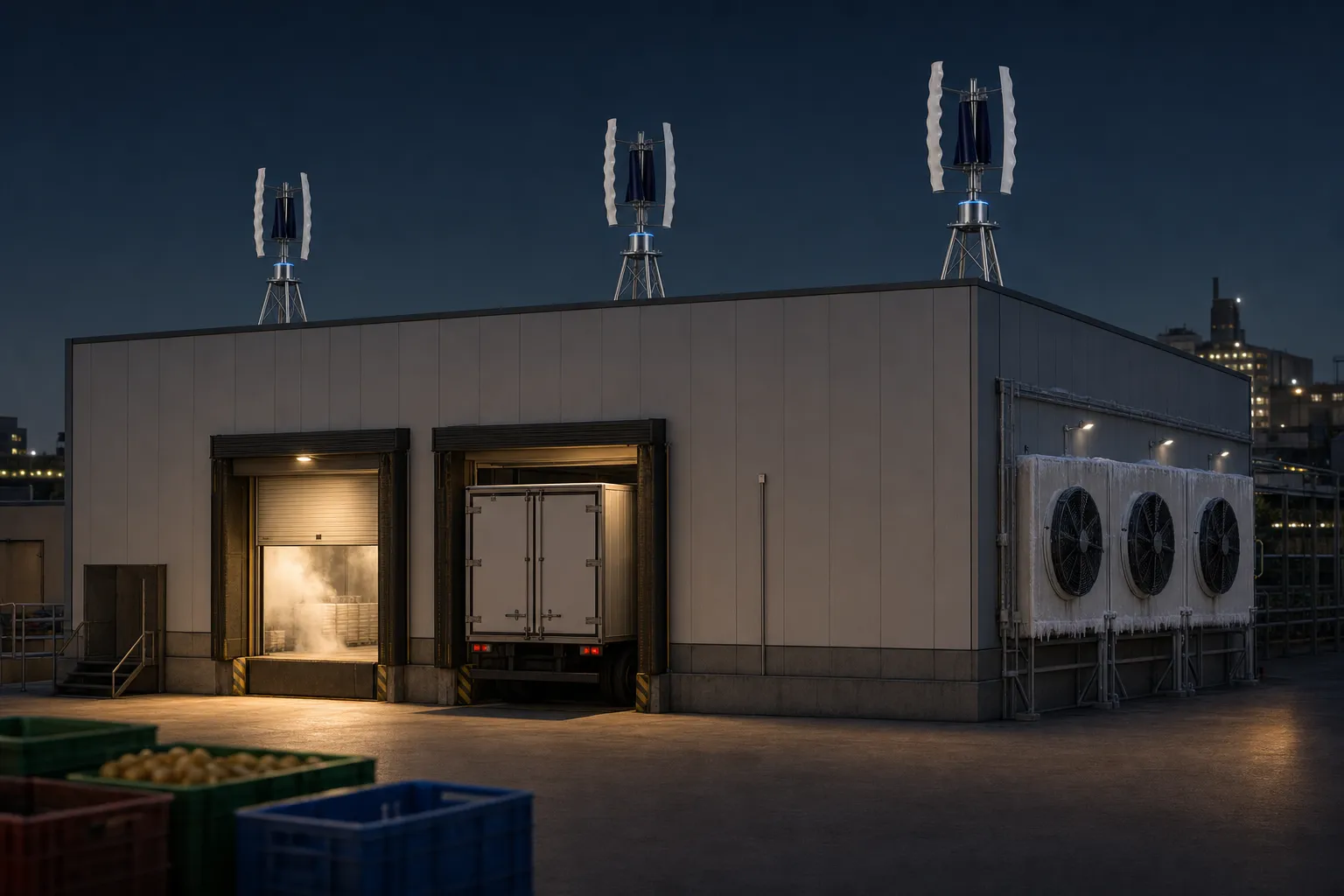
The search for a wind turbine for factory rooftops usually starts somewhere unglamorous: the monthly electricity bill.
Industry consumes more of India’s electricity than any other sector, industrial tariffs carry the grid’s cross-subsidy weight, and for a cold storage the meter never stops — holding 4°C is a round-the-clock promise.
So this page does what most pages on wind power for factories don’t: it takes one factory’s bill apart, line by line, and shows where rooftop wind honestly fits — as a measured supplement to the electricity board’s supply, never a replacement for it.
It’s one branch of the wider map of wind energy for business in India.
One month, line by line.
Machines, motors, lighting, compressed air — the load that tracks production hours. Industry consumes 41.8% of India's electricity, more than any other sector, and most of it flows through lines like this one.
SOURCE · IBEF · POWER SECTORCold rooms don't close at night. Holding temperature is a continuous draw — a bulk cold store typically runs seventy to eighty units per tonne of stored produce each year, and high-throughput hub facilities can reach two hundred — which is why electricity sits among the largest recurring costs a cold storage carries. It's the line that makes a wind turbine for cold storage worth asking about.
SOURCE · NCCD/NHB VIA FMAXUnder the Ministry of Power's Time-of-Day tariff rules, industrial and commercial consumers pay at least 1.2 times their normal rate for peak-hour units — the same electricity, priced higher because of when it's drawn.
SOURCE · MINISTRY OF POWER TOD RULES VIA ENERGY PORTALIndustrial tariffs in India are pushed well above cost-reflective rates — often around 50% higher than efficient levels — to subsidise other consumer classes. A factory's meter pays for more than the factory's power.
SOURCE · POLICY CIRCLEEvery outage hour on a diesel generator produces the most expensive units on the bill — going by published per-unit rates, roughly three to six times what the grid charges industry. For a cold storage those hours aren't optional; the temperature doesn't wait.
SOURCE · EAIIndia runs on industrial power.
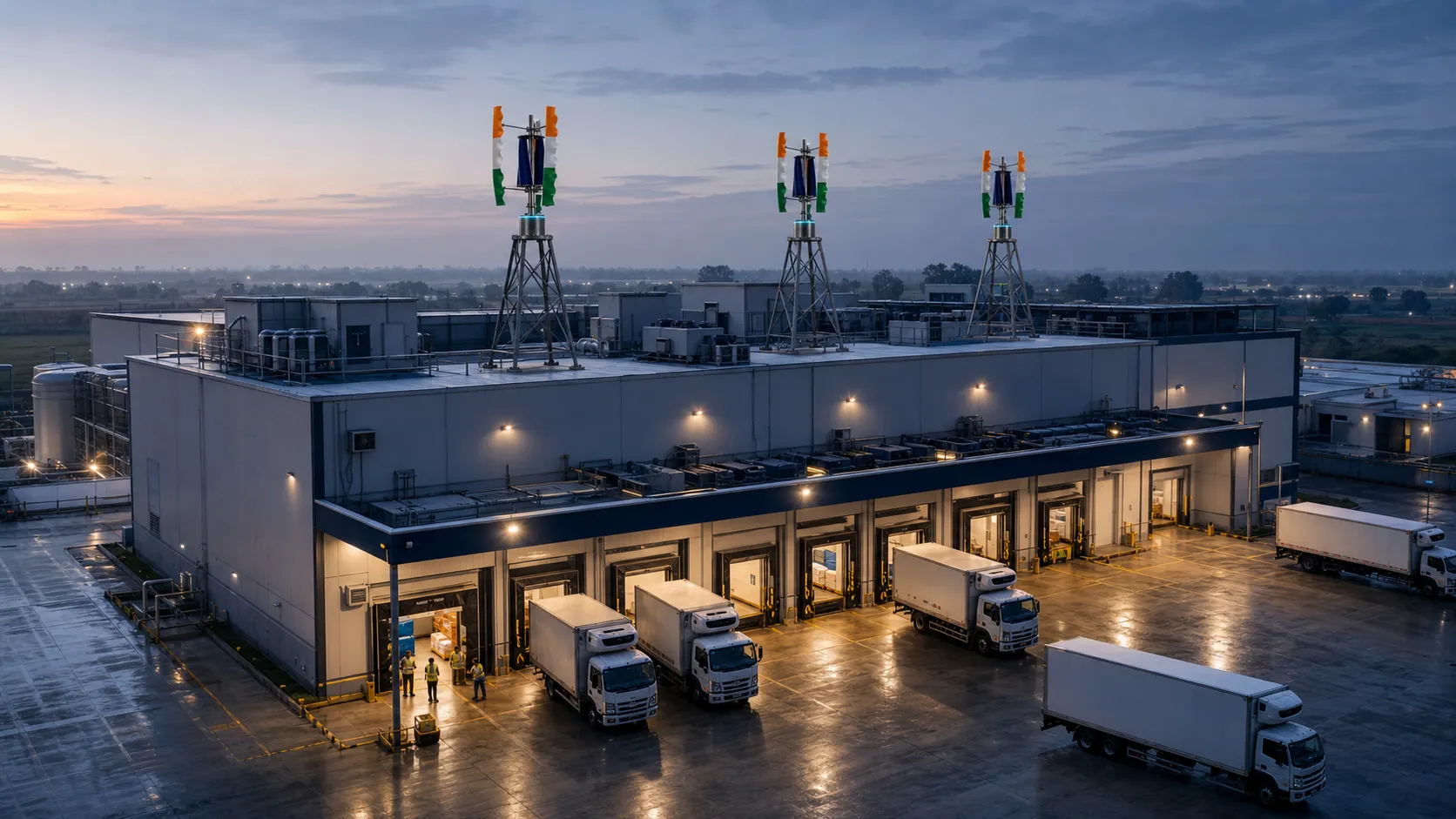
4°C never sleeps
A cold storage is the purest version of the factory problem: the most important load in the building can never be switched off.
Compressors hold temperature through the night, through Sundays, through the monsoon — and every one of those hours is billed.
Here’s the part most factory owners haven’t been told: across India’s grid, wind generation tends to pick up at night and through the monsoon months — exactly the hours and season when solar contributes least.
That’s a grid-wide pattern, not a promise about any single roof. But it’s why wind energy for cold storage in India is worth assessing at all: the resource and the load keep similar hours.

The shift the meter never misses
A manufacturing unit’s load follows its shifts, and its bill follows the tariff clock.
Peak-hour units cost at least 1.2 times the normal rate by regulation, and the tariff itself carries a structural cross-subsidy surcharge before a single machine turns on.
That’s the honest arithmetic behind how to reduce electricity bill in factory operations: you can’t negotiate the tariff, but you can change how many units you buy at it.
First through efficiency, then by generating a measured slice on your own roof. What a rooftop wind machine actually does in practice is the realistic baseline to start from.
How to reduce a factory’s electricity bill — the honest ladder
Every credible answer runs in the same order, and on-site generation is deliberately last.
- First, measure: sub-meter the big loads, because a bill can’t be reduced until it’s understood — which is exactly what the teardown above is for.
- Second, efficiency: insulation and door discipline on cold rooms, compressor maintenance, fixing compressed-air leaks — the cheapest unit is the one never drawn.
- Third, timing: under Time-of-Day tariffs, load shifted out of peak hours is billed at the normal rate instead of the mandated 1.2-times-or-more premium.
- Fourth, generation: solar for the daytime curve, and — where a measured assessment supports it — rooftop wind for hours solar can’t reach.
That ladder, applied honestly, is how to reduce electricity bill in factory settings without a single overclaim.
Which factories and cold storages fit — and which don’t
The pattern that fits is specific: a plant with round-the-clock or long-hours load, an open industrial roof or yard corner without taller obstructions crowding it, and structure that can carry a compact stand — the same shape of site that makes wind turbines for warehouses and logistics parks a natural fit too.
The kind of RCC roof or engineered shed most modern units already have. GIVARA ONE is a full-size rooftop wind machine with a rotor roughly five feet across on a compact stand; it asks for a clear corner, not a field.
A plant hemmed in by taller buildings, or a site where measurement finds genuinely light wind, isn’t a fit — and gets told so.
Size, notably, is not the gate: a small fabrication workshop with an open shed roof and no tall neighbours can measure better than a far larger plant boxed in on every side.
The service shape is the same as everywhere in the GIVARA use-case map: no machine to buy, GIVARA installs, owns, insures and maintains it — backed by the GIVARA Care layer that watches every machine GIVARA puts up.
The plant pays only for metered units priced below the electricity board’s rate — wind energy as a service, explained.
The factory bill is already a national story.
Frequently asked questions
Can a wind turbine run a factory or cold storage on its own?
No. Wind here is a supplement to the electricity board’s supply, not a replacement for it. The board remains the primary source for a plant’s continuous load; wind offsets a measured slice of that load where the site supports it.
How do I reduce the electricity bill in my factory?
In this order: measure where your units actually go, fix efficiency first — insulation, compressor maintenance, leak-free compressed air — shift what load you can away from peak hours under Time-of-Day tariffs, and only then add on-site generation sized to what a measured assessment of your site supports.
Does rooftop wind work at night when cold rooms are still running?
Wind doesn’t keep office hours. Across India’s grid, wind generation tends to pick up at night and through the monsoon — the hours and months when solar contributes least. That’s a grid-wide pattern, not a promise about any single roof, which is why every GIVARA site starts with an on-site wind measurement.
What does a wind turbine for a factory cost to buy?
With GIVARA, nothing — there is no machine to buy. GIVARA installs, owns, insures and maintains the unit, and the factory pays only for the units it generates, priced below the electricity board’s rate.
Can my factory get a GIVARA ONE installed today?
GIVARA is pre-launch, and honest about it. What a factory can do today is register interest, so the site is in line for a measured wind assessment — the step every installation decision starts from.
Your roof could be next — measurement first, always
TELL US ABOUT YOUR SITE