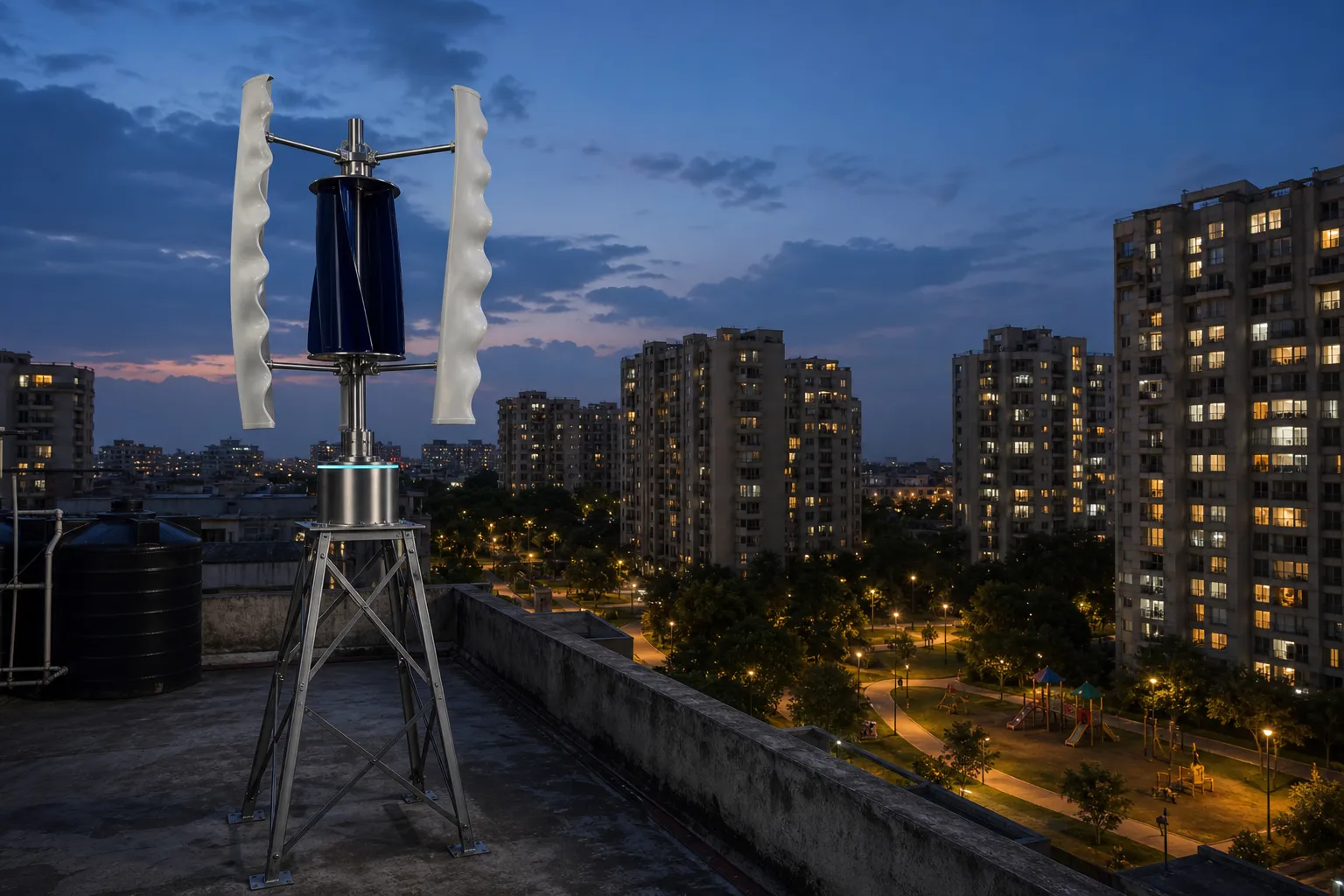
If your managing committee is weighing a wind turbine for housing society common-area power — the lifts, pumps, lobby and compound lights every member’s maintenance bill carries — here’s the direct answer first: the terrace is common area, so the general body decides, not any one member or the committee alone.
Getting RWA approval for rooftop wind turns out to be an easier ask than it sounds, because there’s no purchase for the society to approve.
This page is one branch of the wider map of wind energy for business in India.
The bill every member pays, but nobody owns.
Every member’s maintenance bill carries a share of the common-area electricity:
- Lifts running through the day.
- Water pumps pushing supply up to overhead tanks.
- Lobby and staircase lighting through the night.
- Compound and gate lighting that rarely switches off.
It runs whether anyone notices it or not, and it comes out of the maintenance corpus rather than any one flat’s own meter.
A society’s common-area connection often sits in a different tariff category than a member’s home — your own bill is the authority on that, not a general claim this page could make.
Maharashtra’s model bye-laws — as reproduced by MySocietyClub, a secondary source — treat open and common areas as meant for all members, not for any one member’s own use. In practice that’s the terrace too. Other states’ bye-laws differ in detail, so read your own.
That’s the “nobody owns it” part: everyone pays into the common-area bill, but changing what generates against it is a collective call, the same as any other shared-infrastructure decision a society makes.
And the same model bye-laws already carry a mechanism for exactly this kind of decision: on application, a society is bound to allocate available space for solar and renewable-energy devices.
Wind isn’t named in that clause — but the space-allocation logic for rooftop renewables is already sitting in the society rulebook, waiting to be used. (Practical guidance, not legal advice — your society’s own registered bye-laws are the authority.)
Shared terraces are already an India-scale story.
Your terrace, seen from above.
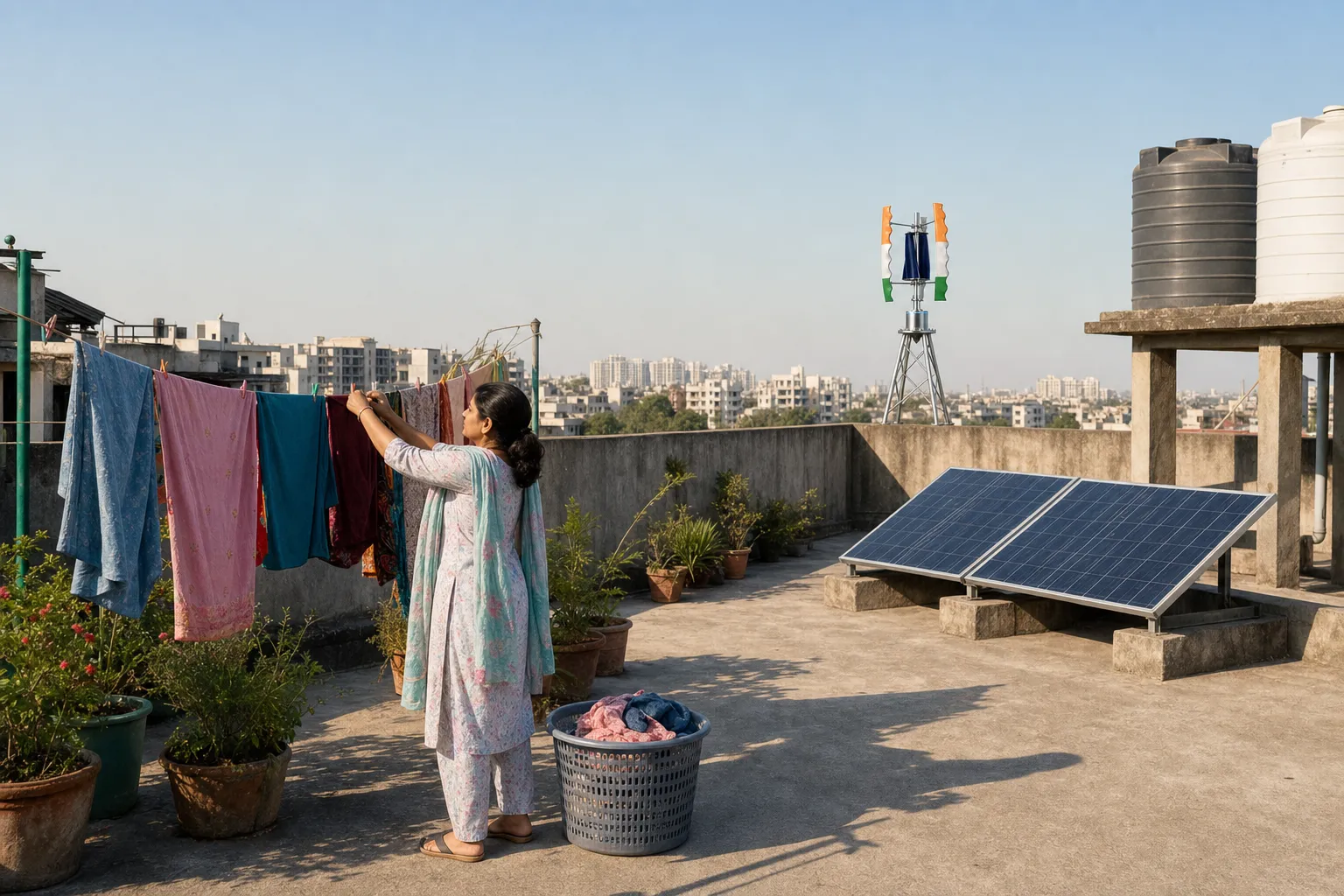
Here’s the honest footprint, shown rather than described: a GIVARA ONE installation takes one corner of the terrace.
The water tanks stay where they are. The drying lines stay where they are.
The stair head, any existing solar array, and everyone’s access to the rest of the terrace stay exactly as they were — nothing about a general-body vote on this changes what the terrace is for on any other day.
It’s worth answering the balcony question here too, since it comes up often from residents who don’t have a say over the terrace but do have a balcony of their own: a single balcony-mounted machine isn’t where meaningful generation happens.
The scale that actually moves a bill is a shared terrace installation serving the whole society, not one flat’s railing.
A compact, dual-rotor vertical-axis machine like GIVARA ONE is built for exactly this kind of shared rooftop placement — our explainer on vertical-axis wind turbines covers the shape without repeating it here.
For a resident, the practical move is to bring the idea to the terrace and the committee, not the balcony.
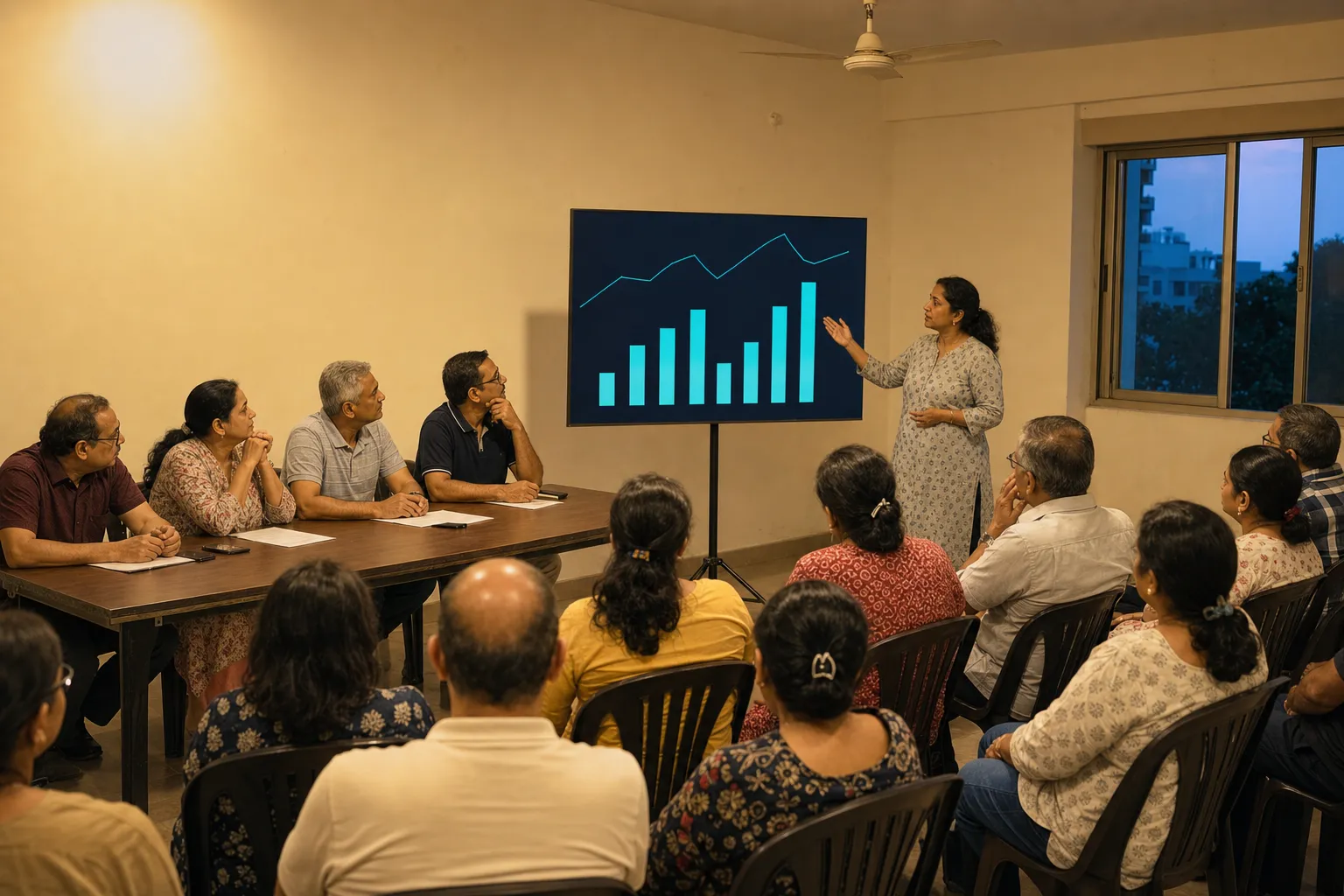
From committee table to general body.
The path runs in five steps.
First, someone raises it with the managing committee — often a proactive member who’s noticed the common-area bill trend.
Second, the committee gets an assessment offer, not a sales pitch: an offer to measure the terrace, plain and simple.
Third, a week-long measurement runs, with the data visible to the committee as it comes in, rather than a vendor’s projection asked to be trusted on faith.
Fourth, the matter goes to the general body with real numbers, not a brochure — under Maharashtra’s co-operative societies law, as RestTheCase’s explainer summarises it, the general body is the society’s final authority, and no other body, including the managing committee, can overrule it — practical guidance rather than legal advice, as everywhere on this page, but it’s why this step is the one that counts.
Societies already run a version of this play for rooftop solar: an agenda item before the AGM, a resolution, an NOC on society letterhead — the same mechanism, applied here.
Fifth, once approved, installation gets scheduled directly with the society. A general body that has seen a week of its own terrace’s wind data is voting on evidence, not enthusiasm.
No purchase for the society to approve.
Here’s what actually changes the approval conversation: the society isn’t being asked to approve a capital purchase.
GIVARA ONE comes as a service — nothing for the society to buy, finance, or maintain out of the corpus fund.
GIVARA installs the machine, owns it, insures it, and maintains it — backed by the GIVARA Care layer that watches every machine GIVARA puts up. The society pays only for the electricity units it actually generates, metered at the point, priced below the electricity board’s rate.
That reframes the resolution itself: not “should we spend society funds on equipment,” but closer to “should we let the terrace host a metered source that only bills for what it produces.”
GIVARA positions itself as India’s first Wind Energy-as-a-Service platform for exactly this reason — ownership stays with GIVARA, the terrace stays the society’s.
See Wind Energy-as-a-Service, explained and the machine itself, GIVARA ONE.
Why housing society terraces can suit rooftop wind
High-rise society terraces sit at a real advantage over an individual bungalow roof: they’re higher off the ground, exposed to airflow a ground-floor or low terrace rarely gets. Height alone tends to mean cleaner, steadier air movement above a building.
That said, height isn’t a guarantee. A terrace boxed in by taller neighbouring towers, or surrounded by structures that create turbulence rather than open flow, can perform worse than a shorter but more exposed rooftop.
That’s exactly why nothing here gets quoted off a floor count or a satellite image — the process starts with about a week of real, on-site wind measurement, the same discipline does my roof have enough wind walks through for a single home.
Regulators are starting to write societies into the picture too: Karnataka’s electricity regulator has explicitly named housing societies in its rooftop-solar net-metering reforms, and Delhi’s 2025 solar policy amendments introduced a capital subsidy specifically for group housing societies and RWAs — policy is beginning to see the society as a unit, not just a collection of individual meters.
None of this makes solar and wind competitors on the same terrace.
Where a society already has a rooftop solar array, a wind installation works alongside it in the corner assessment finds workable, drawing on a different part of the wind resource at a different time of day — the same complementary logic wind vs solar for Indian homes covers for a single house, holding at society scale.
Societies are already part of the rooftop-energy story.
Frequently asked questions
Does the society need a general-body resolution to approve a rooftop wind turbine?
In most societies, yes — model bye-laws such as Maharashtra’s treat open and common areas as shared by all members, so a change to the terrace typically goes through the same general-body process as other shared-infrastructure decisions. This is practical guidance, not legal advice — your own society’s bylaws and registrar rules are the real authority here, and they’re worth checking directly.
Who is responsible if something breaks on our terrace?
GIVARA owns, insures, and maintains the machine for its working life — the society isn’t holding a repair liability for equipment it didn’t buy. See who pays if it breaks for the fuller answer.
Does every member have to agree before installation can go ahead?
That depends on your society’s own process for general-body resolutions — some require a simple majority, others more. GIVARA doesn’t set that threshold; the society’s existing governance does, and a week of measured data simply gives members something concrete to vote on.
Will a wind installation take over our terrace?
No. GIVARA ONE sits on a compact stand in one corner of the terrace. The water tanks, stair head, drying lines, any existing solar array, and resident access to the rest of the terrace stay exactly as they were — the map above shows it plainly.
What if the measurement says our terrace doesn’t have enough wind?
Then GIVARA says so, and the conversation ends there. Nothing gets pitched on a weak site — the society loses a week of measurement, not a commitment.
Housing societies are one entry in a wider family of applications GIVARA is building toward — see use cases for where else on-site wind might fit.
Your roof could be next — measurement first, always
TELL US ABOUT YOUR SITE