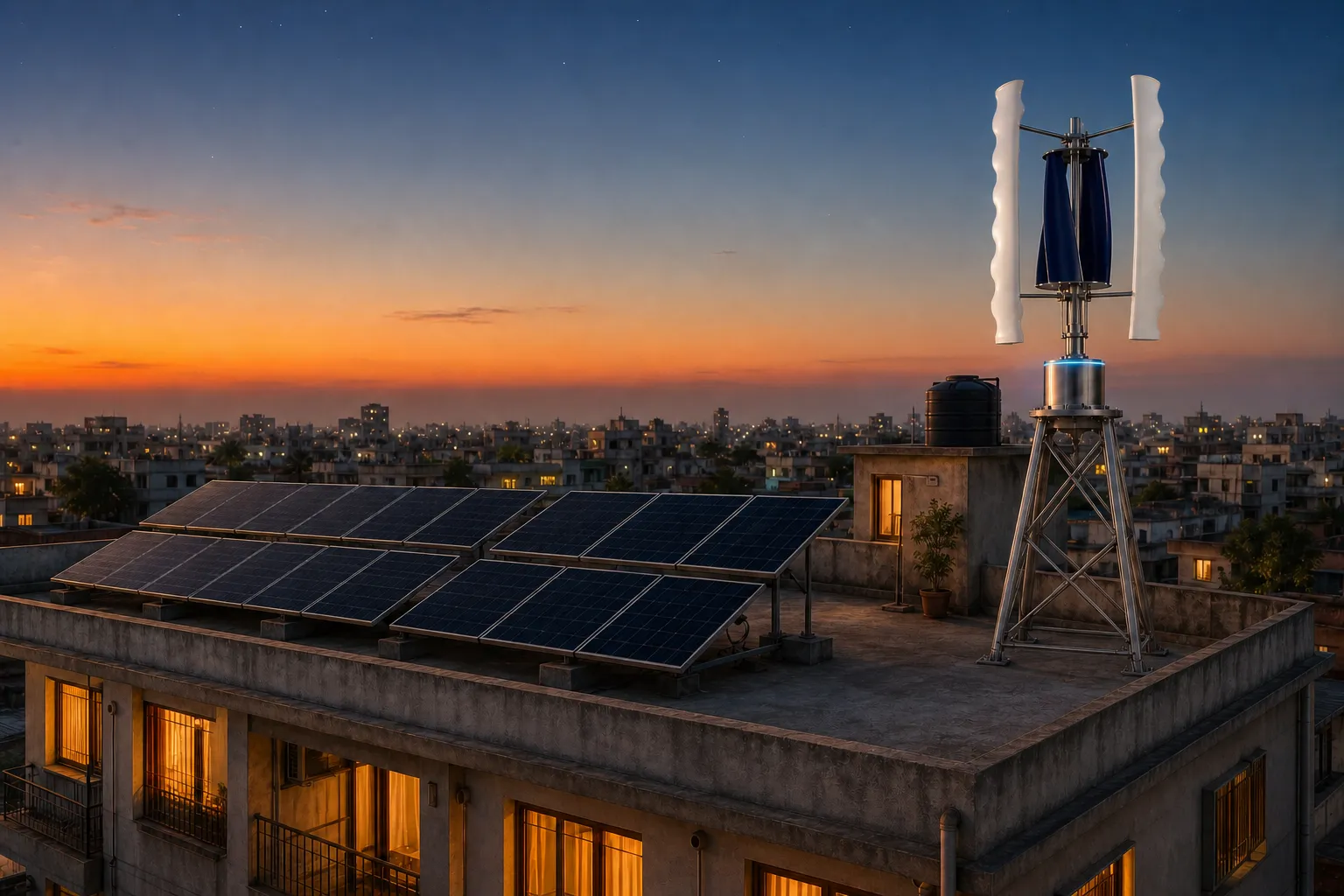
Ask about wind vs solar for Indian homes and you’ll usually get pushed toward picking one. Wrong question — both answers miss the point, because the question itself sends people down the wrong path.
The right question is simpler: what does your home need power for, and when does it need it?
Solar answers half of that question extremely well. Wind, done properly, answers the other half. Neither replaces the other.
Solar earned its place — and keeps it.
Solar owns the day — and it should
Rooftop solar has earned its place on Indian roofs. The technology is mature, installers are everywhere, and if you have the roof space and the budget to own a system outright, solar is an excellent decision. No version of this article argues otherwise.
But solar’s honesty is also its limit: it only makes electricity while the sun is up. Before sunrise and after sunset, it does nothing at all — not less, nothing.
Your home peaks — after sunset.
The evening gap: when Indian homes actually need power
Walk through a typical Indian home’s day and look at when the load actually happens.
- Mornings are light — a few lights, maybe a geyser.
- Midday the house is near-empty — everyone’s at work or school.
- Evening is everything at once — lights in every room, the TV, fans and AC, dinner, water heated again.
That stretch is when most Indian households spend most of their electricity — and it’s exactly when a solar panel has nothing left to give. This isn’t a flaw in solar. It’s just physics.
Your home's day, and what each source can reach.
Solar's day ends at sunset — exactly when an Indian home starts spending most of its electricity. Wind is variable — some evenings the air is lively, some it's still — but when it's there, it works the hours solar structurally can't reach.
Battery storage can bridge some of that gap, but batteries add their own cost and complexity to a system that was already a serious upfront commitment. For most households, the evening gap simply stays a gap.
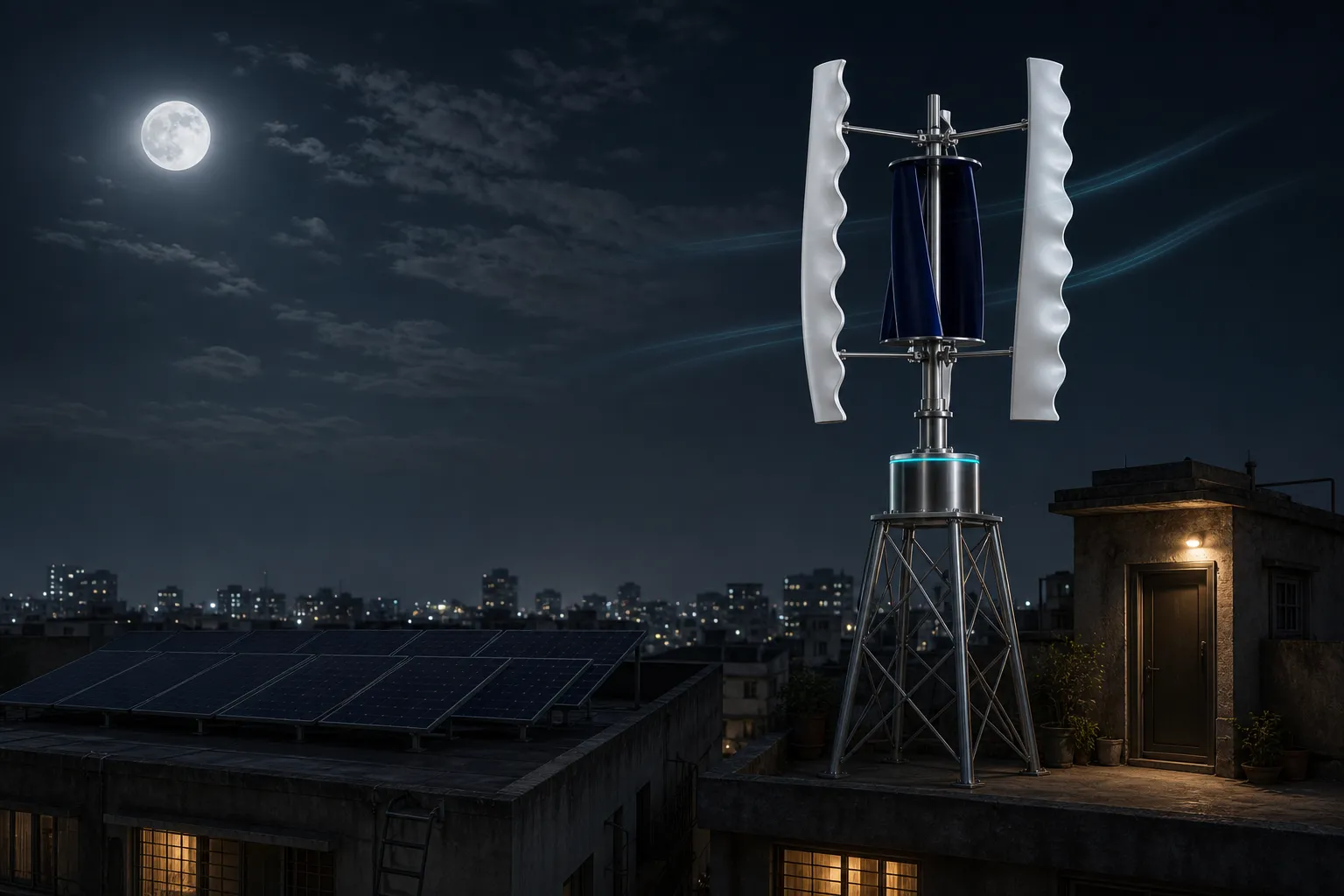
It can't read a clock — that's the point.
Wind doesn’t care what time it is
Wind blows on its own schedule, not the sun’s. Some days the air over your roof is lively, some days it’s still, and no one, including us, will promise you otherwise.
But when the wind is there, it doesn’t check the clock — a breeze moving over a rooftop at 9 p.m. turns a turbine exactly as well as one moving at 9 a.m.
That matters again during the weeks solar structurally underperforms — the monsoon. Heavy cloud cover cuts straight into a solar system’s output for weeks at a stretch, while some of the windiest weather of the year arrives wrapped inside monsoon systems.
None of this means wind is “better” than solar for daytime generation — it isn’t, and pretending otherwise would be the same overselling this article is trying to avoid. Wind is simply shaped differently. It fills hours and weeks that solar structurally can’t reach.
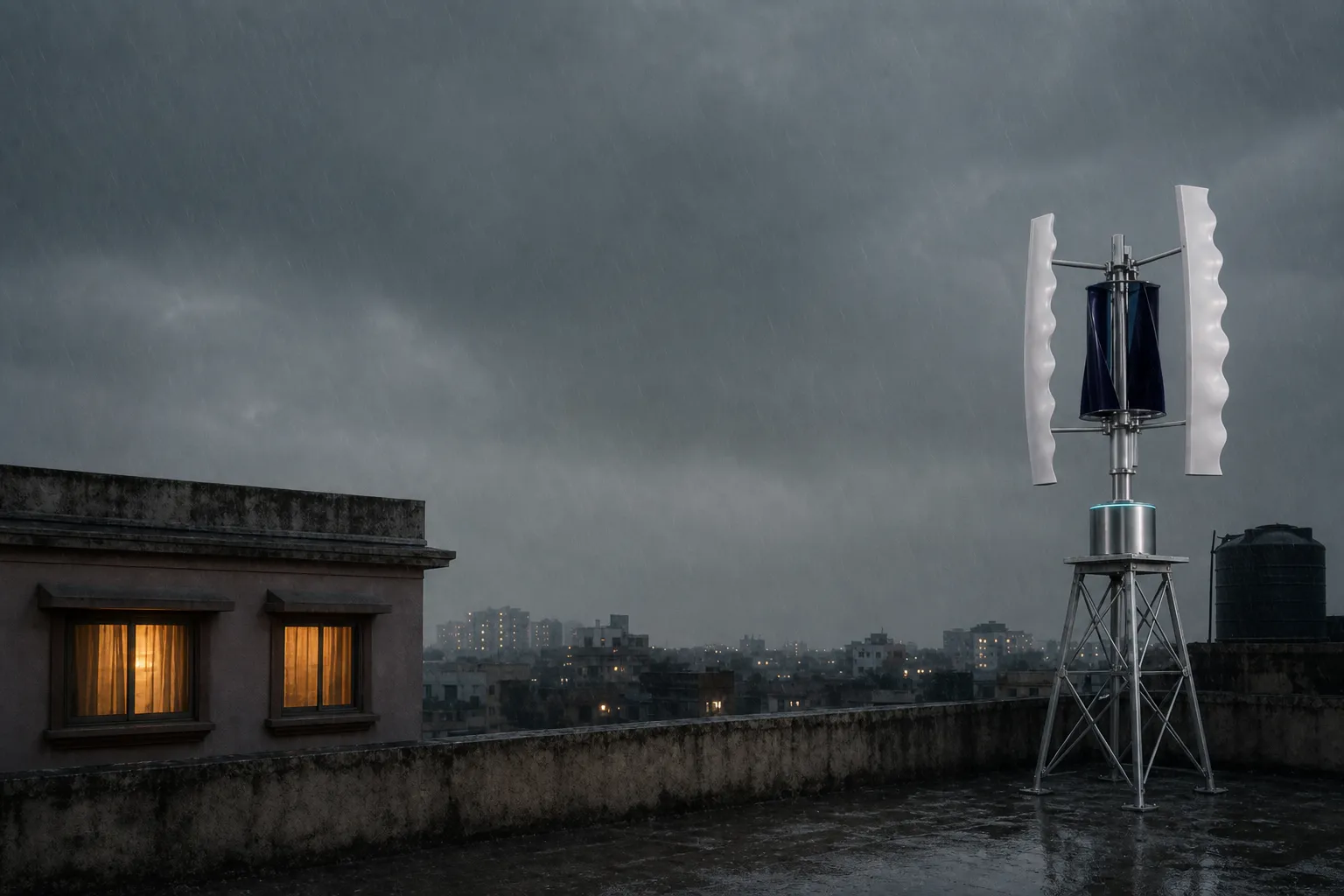
Two shapes — one bill.
Why wind vs solar is a complement, not a competition
Two sources with different shapes, pointed at the same bill, is a better outcome than one source doing everything alone.
This is where GIVARA ONE fits into the picture differently than a second solar array would. It comes as a service — India’s first Wind Energy-as-a-Service platform — which means there’s no machine to buy, finance, or maintain.
GIVARA installs it, owns it, insures it, and maintains it; you pay only for the electricity it actually generates, measured at your own meter.
Solar owners aren’t asked for a second big-ticket decision. Still-deciding homes aren’t asked to skip solar. They’re not drawing from the same decision.
One corner for wind — the rest stays solar's.
What wind and solar look like on the same roof
Wind won’t work on every roof, and GIVARA is upfront about that from the start. A turbine needs airflow the way solar needs sunlight — but rooftop airflow is shaped by everything around it: neighbouring buildings, terrace walls, which direction your roof faces.
Guessing at that from ground level doesn’t work, which is why the process starts with a real measurement of your specific roof, for about a week.
Roof space isn’t the constraint either way: wind takes one corner on a compact stand; the terrace where solar sits stays exactly as it was — they simply aren’t competing for the same square footage. A roof already dominated by a solar array can usually still find a corner free for wind.
Where you live in India matters more for wind than for solar. Coastal stretches, higher floors, and sites with open approaches tend to have more usable wind than a boxed-in ground floor wedged between taller buildings.
RWAs and housing societies bring their own approvals process, same as any rooftop installation. None of this is a reason to assume wind won’t work — it’s a reason to measure instead of guessing.

Frequently asked questions
Do I need solar panels before I can get GIVARA ONE?
No. Wind and solar are independent systems on your roof. You can have GIVARA ONE with solar, without solar, or before you’ve decided about solar at all — the decisions don’t depend on each other.
Will a wind turbine and solar panels get in each other’s way on the same roof?
Generally no. GIVARA ONE sits on a compact stand in one corner of the terrace; solar panels typically cover open, unshaded roof area elsewhere. The main thing that matters is that the turbine’s corner has clear airflow, not that it’s far from the panels.
Is wind actually reliable enough to matter, compared to solar?
Reliability means something different for each. Solar is predictable — daylight arrives every day. Wind is variable — some days and nights are windier than others. Because of that variability, GIVARA measures your specific roof for about a week before anything is installed, instead of assuming wind will behave a certain way.
Does rooftop wind work during the monsoon, when solar output drops?
Often better than solar does, since heavy monsoon cloud cover cuts directly into panel output while wind is unaffected by cloud cover and can pick up during monsoon weather systems. How much your specific roof gets is still something only a real measurement can answer.
Should I get wind or solar first for my home?
They’re independent decisions, so there’s no required order. If you have the roof space and the budget for solar, get solar — nothing about wind changes that. Wind comes as a service with no machine to buy, so it isn’t a second big-ticket purchase decision — and it starts with a measurement of your roof’s actual wind, not with a purchase.
Browse use cases to see where rooftop wind tends to make the most sense, read what actually works on Indian roofs, see who pays when something breaks — or become a partner if you’re thinking at a site level rather than a single home.
Your roof could be next — measurement first, always
TELL US ABOUT YOUR ROOF