
Search “wind turbine for home price in India” and you’ll usually land on a number-shaped hole where the real home wind turbine cost should be. A quote for the machine. Maybe a per-unit estimate scribbled by a dealer.
What that number leaves out is almost everything that decides whether owning a turbine actually works out for you.
A rooftop wind turbine isn’t a single purchase. It’s a system — hardware, structure, paperwork, and years of upkeep — and the machine itself is usually the smallest line in that system.
The part every dealer quotes first — because it's the easy part.
The machine is the easy part to price
Rotor, generator, controller, the wiring that ties it to your meter — this is the part every dealer photographs and quotes first, because it’s the part with a fixed shape.
It’s also the part buyers compare most, the way you’d compare two refrigerators on a showroom floor.
But a turbine isn’t a refrigerator. It sits outdoors, above your roofline, spinning through every monsoon and every heat wave it will ever see.
Build quality that looks identical in a brochure can age very differently once salt air, dust, and a few real storms get involved. The quote tells you almost nothing about year five — or about what actually works on Indian roofs in the first place.
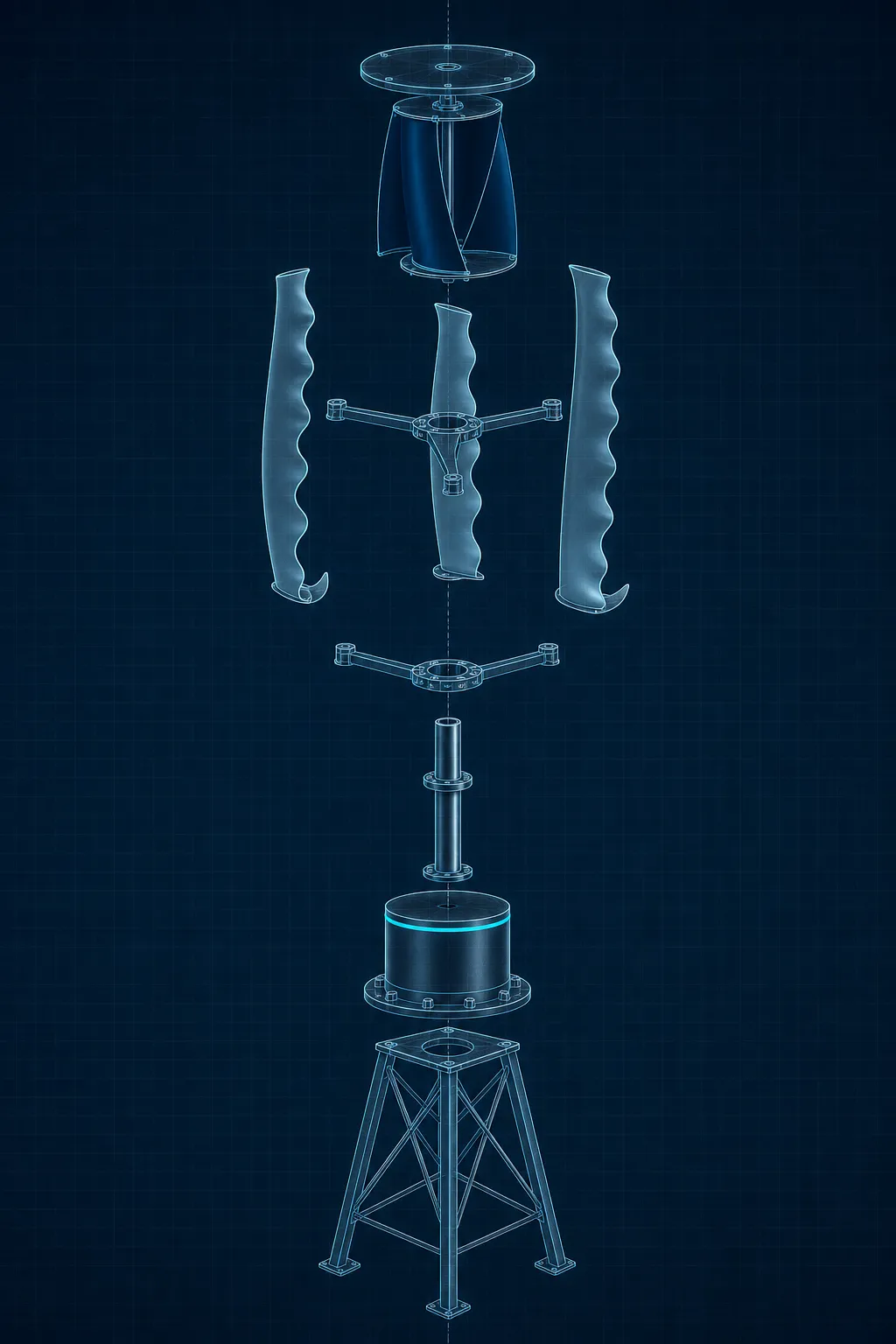
The quote is the tip — the iceberg is the cost.
What a home wind turbine really costs in India
Structure and roof work often rivals the machine itself. Most Indian roofs weren’t built with a spinning machine at height in mind — a structural engineer’s honest look comes before anything goes up, not after.
Permissions are a cost of their own — your RWA, municipal building rules, your electricity board’s net-metering process. None of it is exotic, but real friction has a cost even when no invoice gets raised for it.
Upkeep is recurring, not one-time — solar panels have no moving parts, but a turbine’s entire value comes from a part that moves, which means it’s also the part that wears.
Insurance and repair are the bills nobody quotes upfront — and once the warranty ends, they’re yours to arrange and pay for.
Monitoring is what tells you if any of it is working — without it, you find out from a bill that doesn’t add up.
The price you compare is the smallest number in the story.

Not two turbines — one real decision.
Two ways to pay for home wind power
Add all of that up and a homeowner is really choosing between two different ways of paying for wind, not two different turbines.
Same wind. Two very different deals.
You buy the machine — and everything under the waterline comes with it:
…and every risk on that list is yours to carry.
You never buy the machine. You pay only for meter-verified units — priced below the electricity board's rate.
Everything on the left — the machine, the structure, the paperwork, the insurance, the watching — stays GIVARA's.
A homeowner isn't choosing between two turbines — they're choosing between two ways of paying for wind.
This is the model behind GIVARA ONE. GIVARA built India’s first Wind Energy-as-a-Service platform on the belief that a family shouldn’t have to become a part-time power-plant operator just to get a smaller electricity bill.
GIVARA owns the turbine, handles the structural and permission work, insures and maintains it, and keeps watch on it. You never buy a machine. You pay only for meter-verified units, priced below your electricity board’s rate.
If a week of measuring your roof’s actual wind says the site doesn’t support one, GIVARA says so honestly and nothing changes for you. See how the full ownership arrangement works.

Ownership suits a few — service suits the rest.
Who each way of paying suits
Ownership tends to suit sites with real technical capacity on hand — in-house maintenance staff, a standalone site that wants full equipment control, or a buyer who genuinely wants to manage the asset.
Service suits almost everyone else — homeowners, RWAs, and commercial roofs like warehouses and logistics parks that want a smaller bill without a structural project, an insurance policy, and a maintenance schedule. It also suits anyone who’d rather test whether wind works on their specific roof before committing capital.
You can see how this plays out across different kinds of sites in GIVARA’s use cases.
Frequently asked questions
Is a home wind turbine cheaper than solar?
It depends on the site and on whether you’re comparing ownership to ownership, or ownership to a service. What’s true regardless: wind and solar aren’t really competing for the same hours. Solar works through the day; wind can keep working after sunset and through cloudy, rainy weeks when panels go quiet. On many roofs the two complement each other rather than replace one another.
Do I need my RWA’s or society’s permission before installing one?
Almost always, yes — the same way you would for a rooftop solar installation. Anything mounted at height and visible from neighbouring units typically needs a society or building sign-off, alongside your electricity board’s net-metering process. This is exactly why site assessment and paperwork should happen before you commit to any equipment, not after.
What happens if the turbine breaks down — who pays?
Under ownership, you do, once the manufacturer’s warranty ends. Under a service model like GIVARA’s, GIVARA does — always. The machine, its insurance, and every repair stay GIVARA’s responsibility for as long as it’s on your roof, because you were never the one who bought it.
Can a wind turbine actually work on my specific roof?
Nobody can answer that from a brochure — it depends on your building’s height, what surrounds it, and how the wind actually moves across your terrace, not on a general figure for your city. That’s why an honest process measures your roof directly before anyone quotes you anything, and is willing to say no if the numbers don’t support a yes.
What does a home wind turbine cost per month under the service model?
There’s no machine purchase and no fixed rental — you pay only for the electricity the machine actually generates, metered at your home and priced below your electricity board’s per-unit rate. If the machine generates nothing, you pay nothing for it. The exact per-unit price comes only after your roof’s wind has been measured, because an honest number can’t come before the measurement.
Start with whether your roof qualifies — measure first. See how a vertical-axis wind turbine actually works and who pays when something breaks. Or read how the service model works end to end.
Your roof could be next — measurement first, always
TELL US ABOUT YOUR ROOF